Sentinel Core
Control intelligence for Oracle Fusion
Who can do what, what actually happened, and whether it was approved, read from Oracle Fusion and brought together in one calm, explainable view.
Access and segregation of duties
See who can do what, and where duties collide, entity by entity
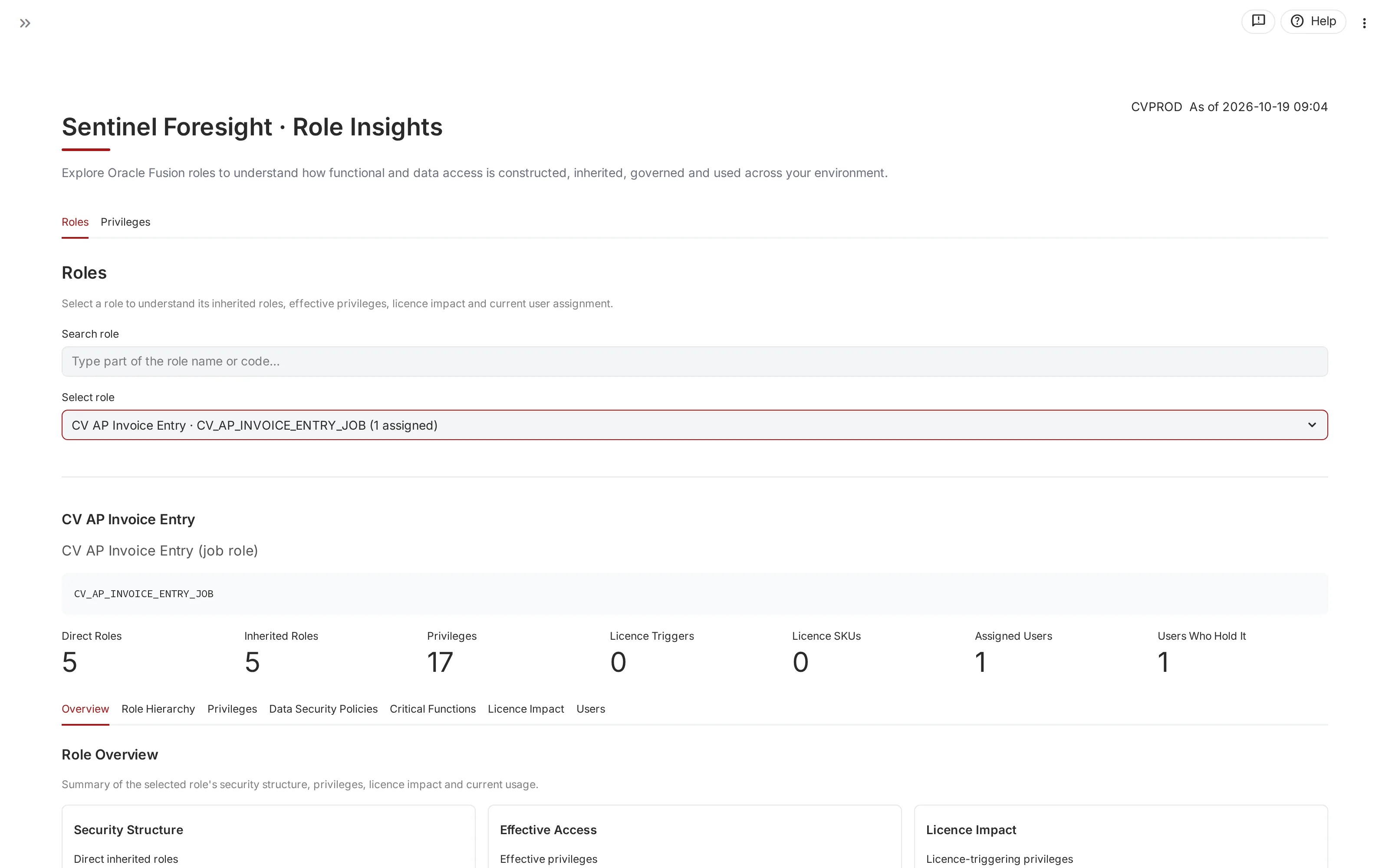
Role and user insights for Oracle Fusion show what each role grants and who holds it. Segregation of duties analysis goes down to the legal entity. Sentinel maps each user’s data access (business units, ledgers and data access sets, inventory and cost organisations, asset books) to the legal entity it belongs to, and records a conflict only where one person holds both sides of a rule in the same entity. A system-level check flags someone who raises invoices in one entity and pays suppliers in another; in a multi-entity organisation that buries the real conflicts in noise. By entity, the review goes where the risk is.
- Conflicts found per user and legal entity, from Oracle’s own data access
- Approved risk deviations per legal entity, time-limited and with their evidence
- Role insights: what a role contains and who uses it
- User insights: a person’s roles and the functions they reach
Change and audit monitoring
What actually changed in Oracle
Sentinel reads Oracle’s own records of activity and brings them together in one place, so changes are seen rather than searched for.
- Oracle audit trails
- Security changes: roles, users and assignments
- BI Publisher and OTBI catalogue activity
- Password resets
- SOA audit
Correlation with change management
Every change matched to the request behind it
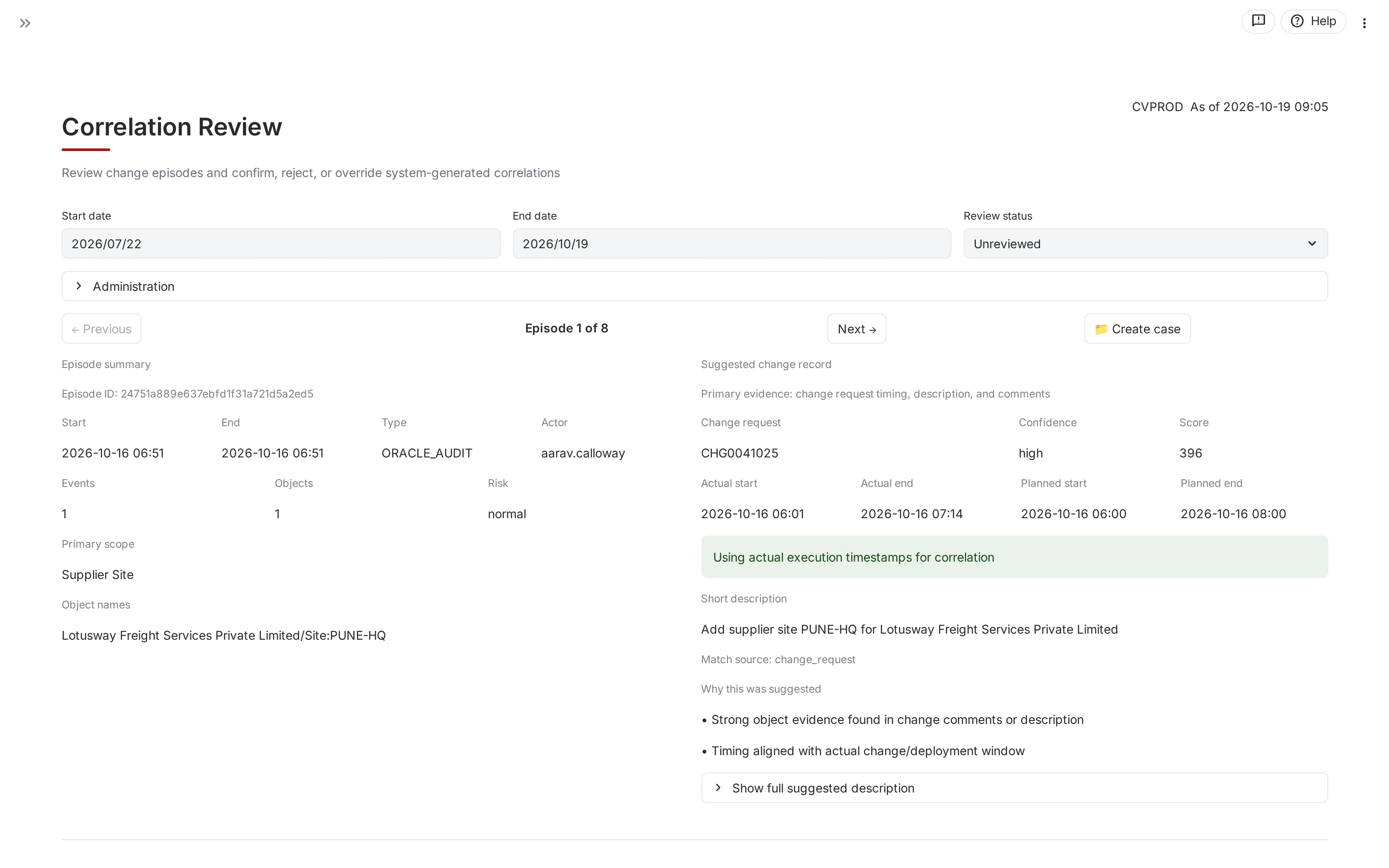
Sentinel imports change requests and deploy tasks from your change management tool, such as ServiceNow, read-only through its API. It groups Oracle activity into change episodes and matches each one to the change request that explains it, and shows why: object names in the change notes, a matching reference, the change window, and who carried out the deploy task. A reviewer confirms or corrects every match.
- Change requests and deploy tasks, mapped to your own fields and filters
- Change episodes instead of raw log lines, prioritised by risk
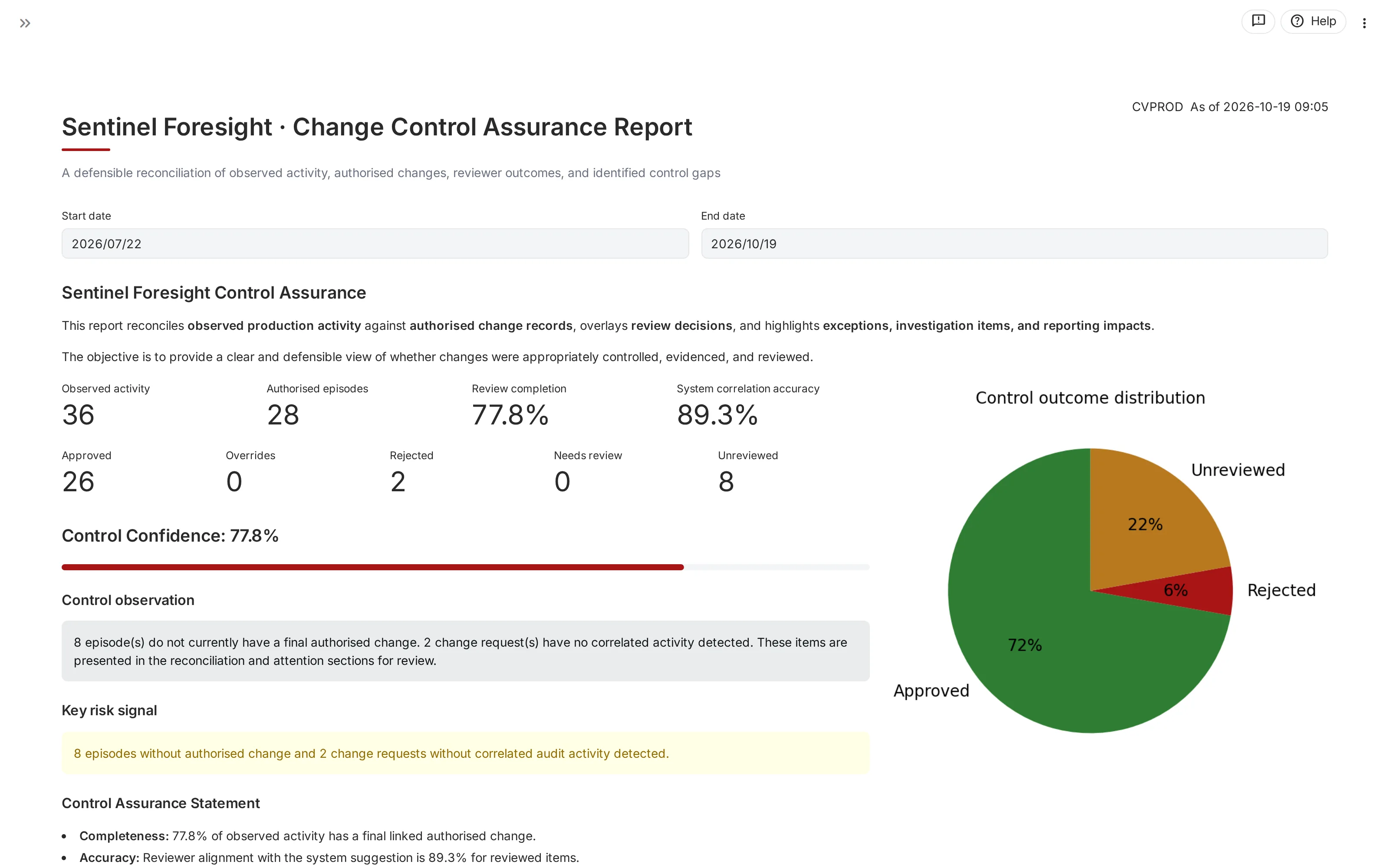
- Seen from both sides: changes with no request, and requests with no change in Oracle
- Key reports: whether each change is backed by an approved change request
- Change process maturity, measured period by period
Key reports (IPEs)
A full change history for every key report
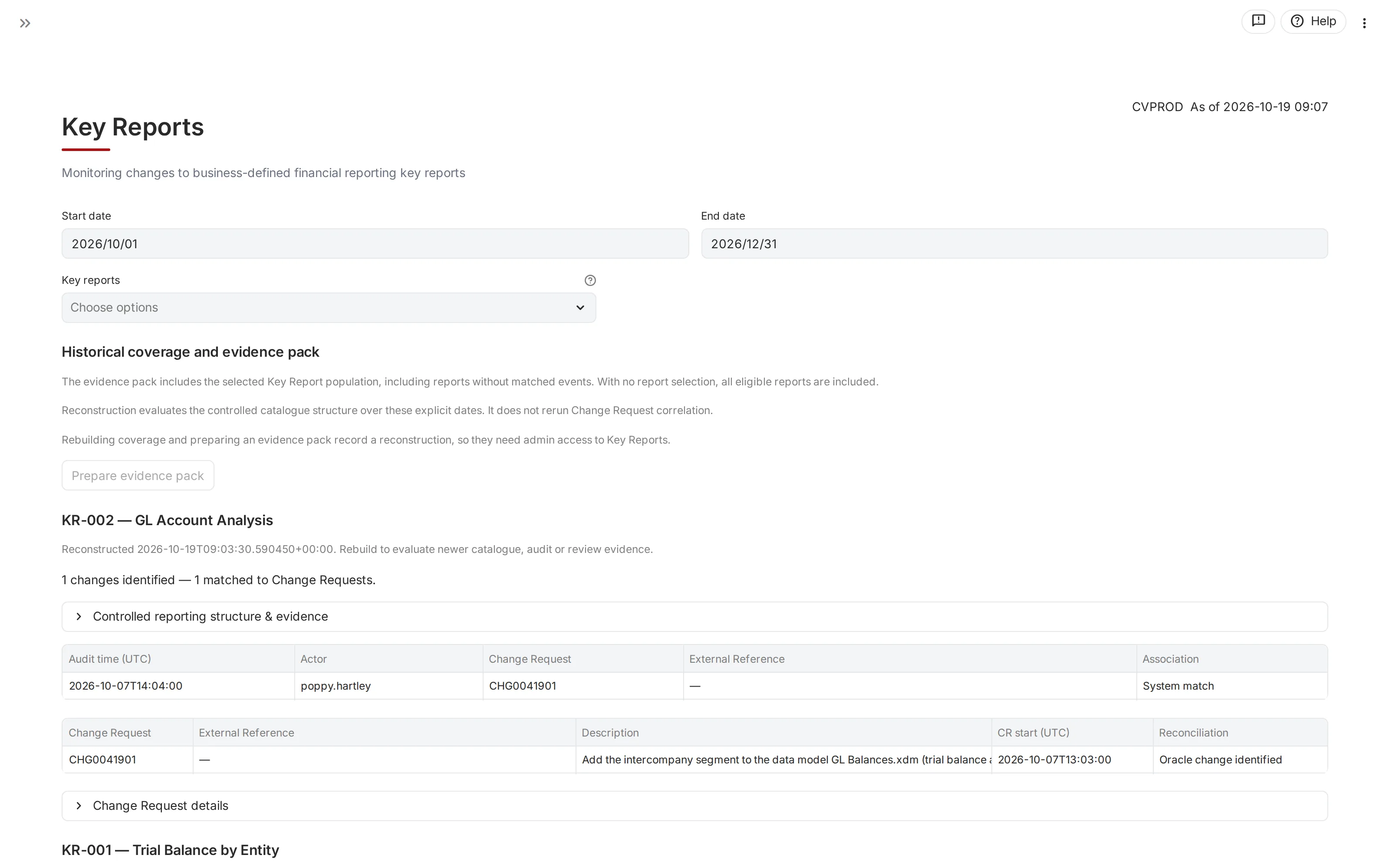
Many controls rest on reports from Oracle: your key reports, or IPEs (information provided by the entity), which auditors rely on. You choose your key reports, and Sentinel finds everything behind each one: the data model, analyses, prompts and dashboard pages. You see when each report changed, and every change Oracle records should link to a change request. That is strong evidence of control, with the full change history for each report there when the auditors ask.
- Choose the report; Sentinel links its data model, analyses, prompts and dashboard pages
- Changes to any linked object tracked over time
- Each change matched to its change request, or shown without one
- An evidence pack for any period, in PDF and Excel
Making sure each change was properly tested before it was deployed remains your responsibility.
Case management
From finding to recorded decision
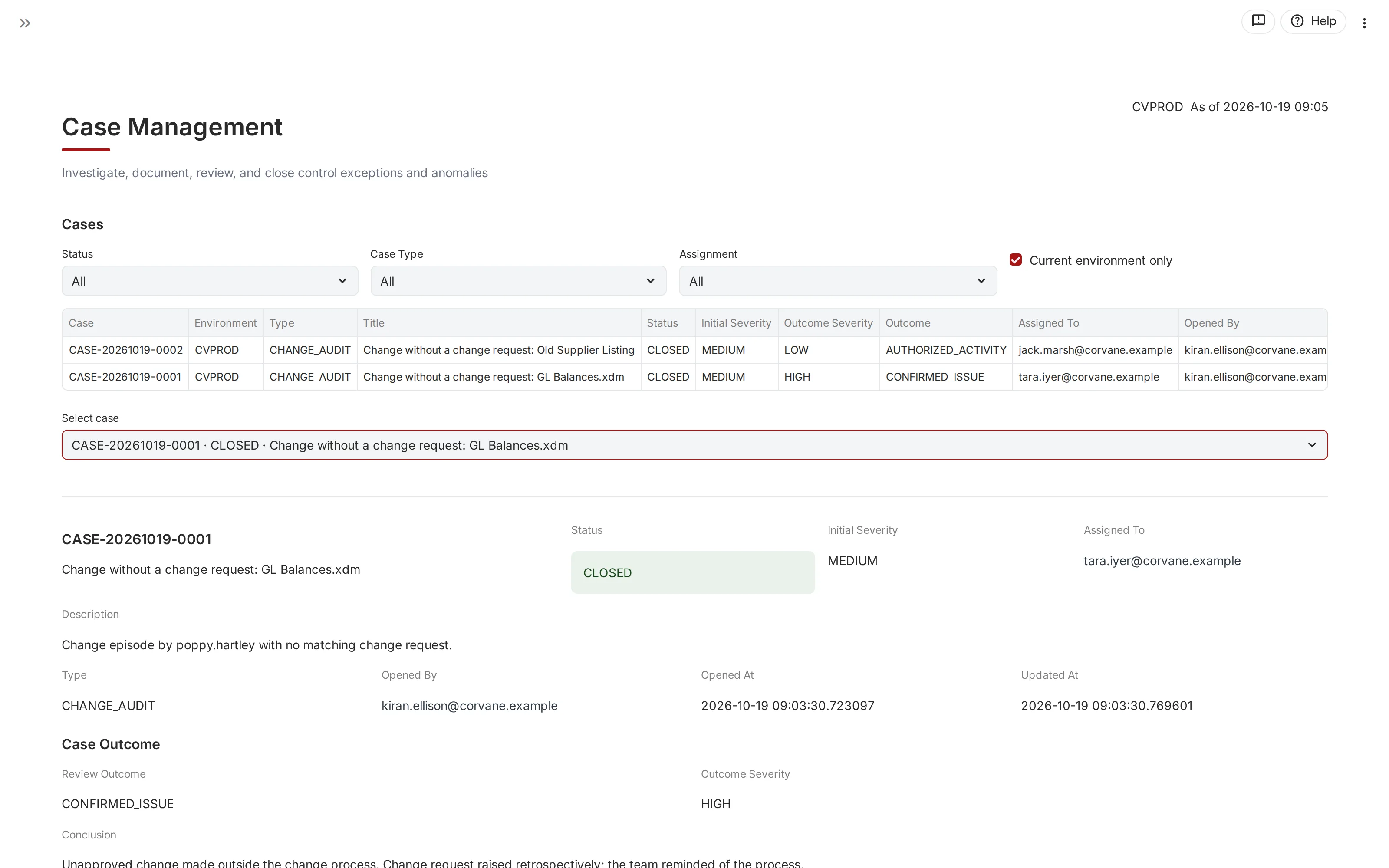
When a correlation does not hold up, or Sentinel finds high-risk activity such as a behavioural anomaly or a sensitive access event, you open a case on it and work it through to a reviewed conclusion. The trail of decisions is your evidence.
- Opened from the finding, with what raised it attached
- Evidence, comments and a written conclusion
- Closed by a supervisor who did not work the case
Licence compliance
See licence exposure before Oracle does
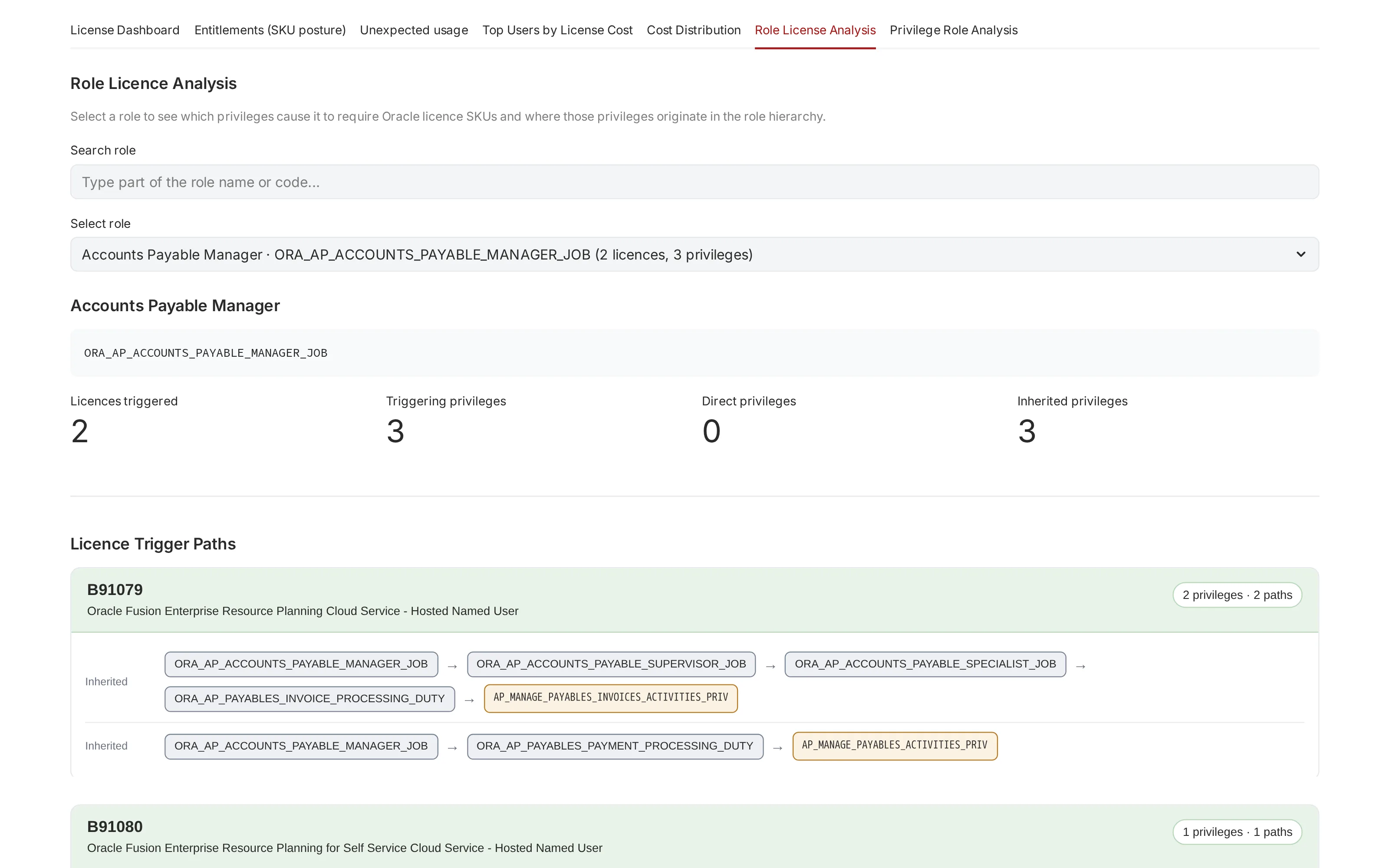
Fusion licensing is easy to get wrong. Roles built from Oracle’s seeded roles often carry privileges nobody needs, and some of those privileges trigger licences. In our experience, many organisations under pressure to go live first hear of it from Oracle, with a request to buy more, and even after go-live few developers know what triggers a licence. Sentinel shows which roles and privileges trigger which licences, compares what your users need with what you have bought, and lets you see the impact before it reaches production.
- Which roles and privileges trigger a licence, including roles nobody holds yet
- Planned role assignments checked in a test environment before a big deployment
- What your users need against what you have bought, by legal entity and by role
- Trends in production, so unexpected usage shows early
- Measured against Oracle’s published references
Configuration Explorer
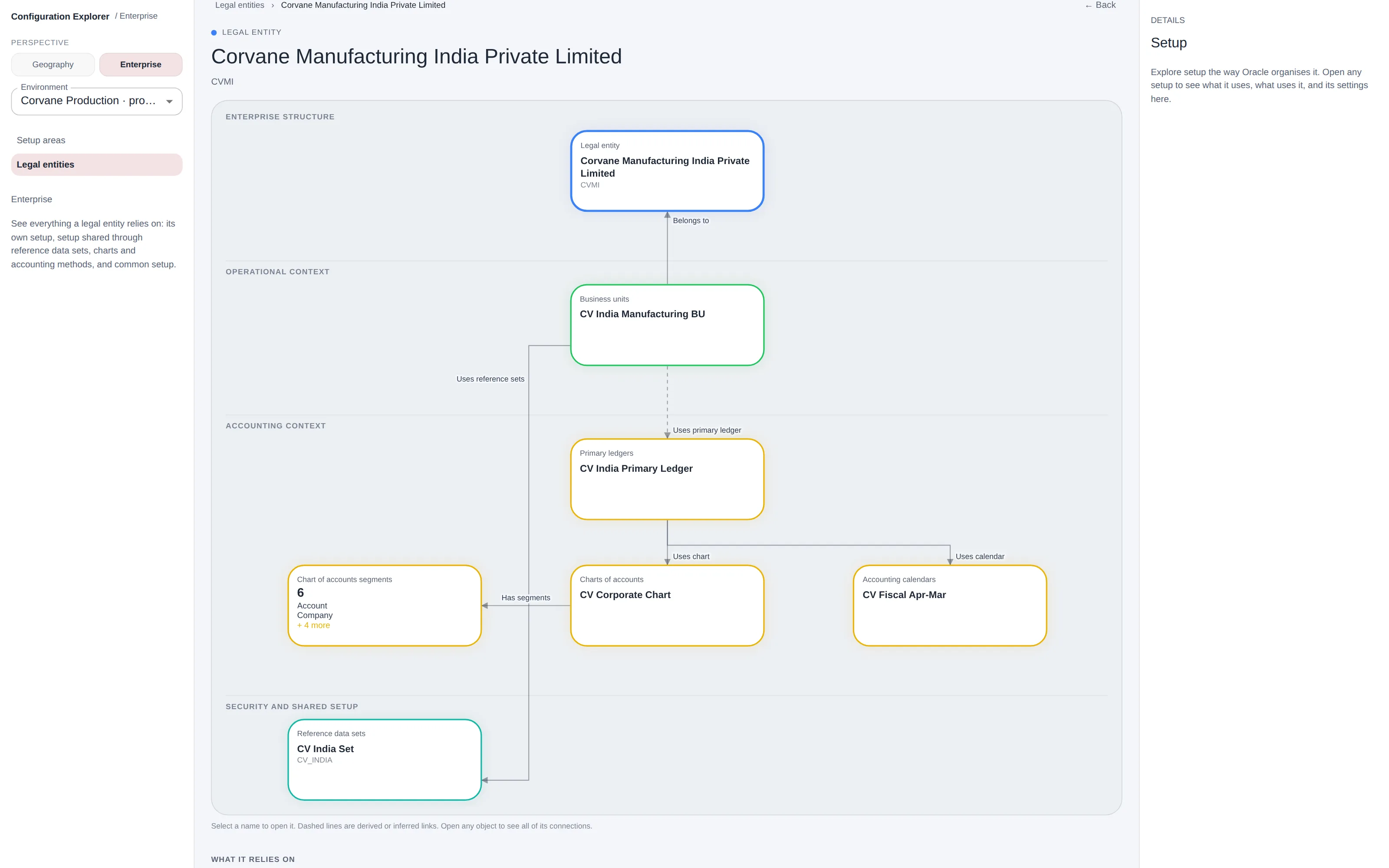
Each legal entity, and everything it relies on
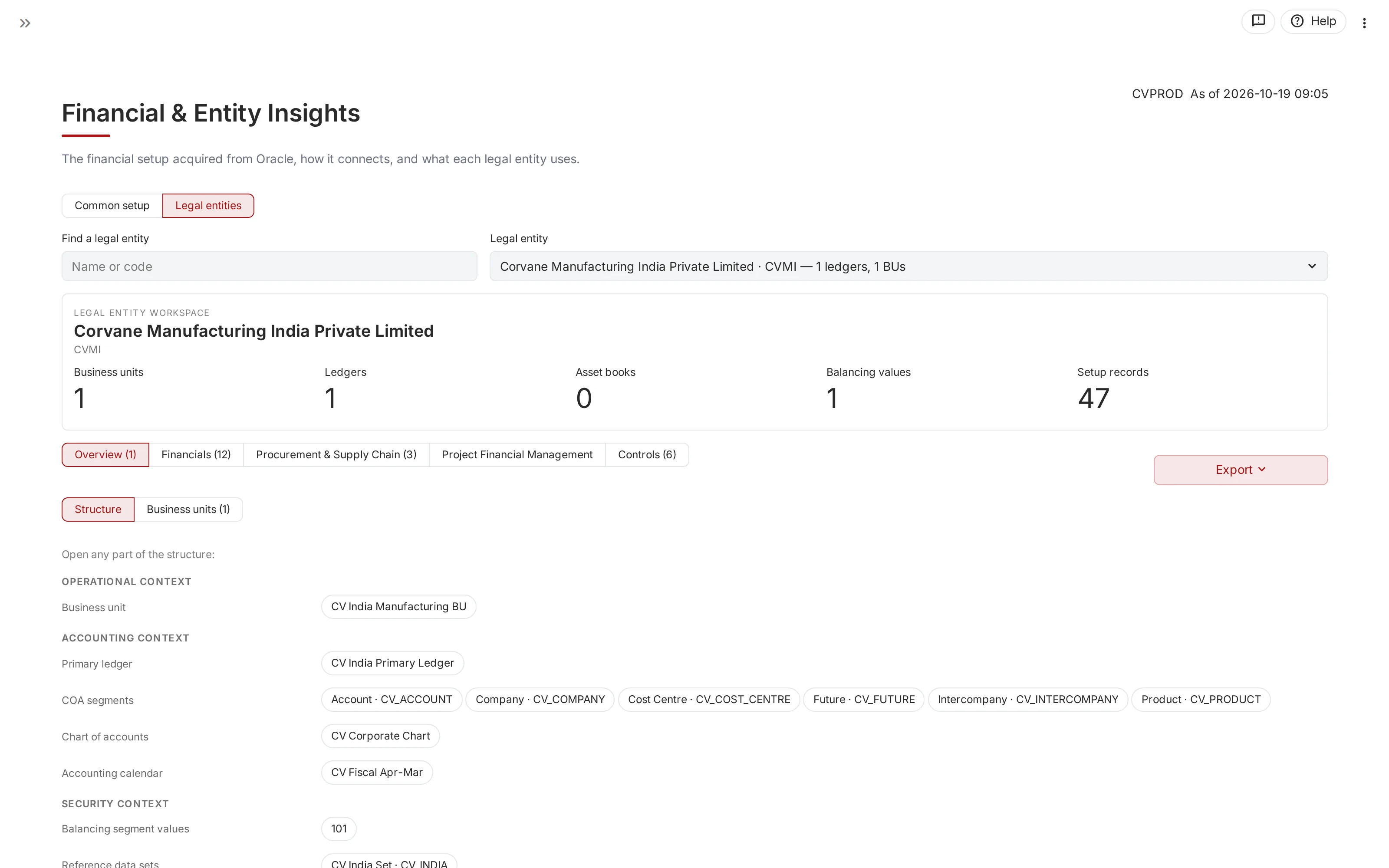
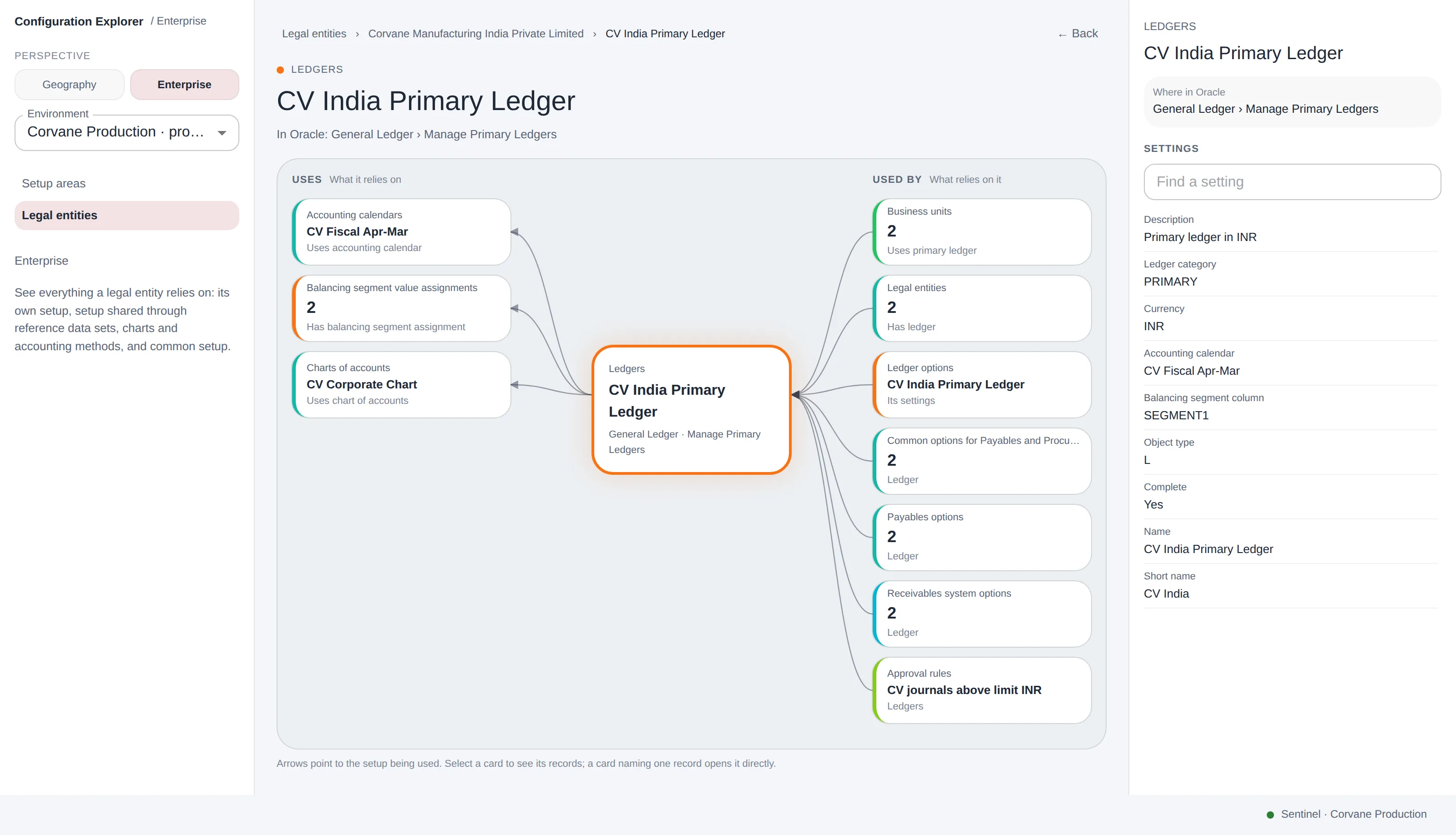
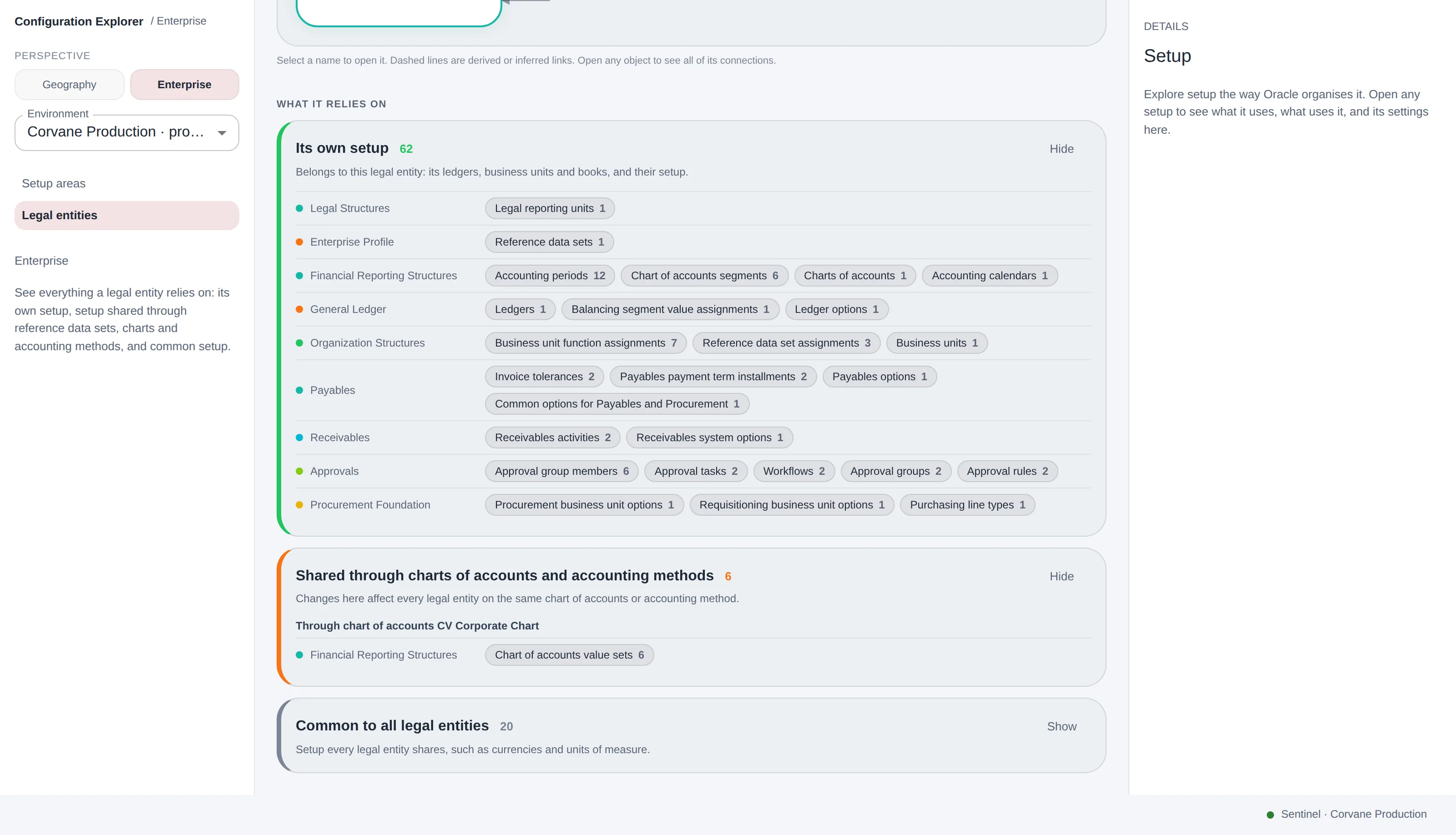
Configuration Explorer draws a legal entity’s structure as Oracle records it: its ledgers, business units, asset books, and inventory and cost organisations, with the links between them. The footprint goes further, to everything the entity relies on: its own setup, the setup it shares with other entities through reference data sets, charts of accounts and accounting methods, and the setup common to all. Before a change, you can see which other entities it reaches.
- Legal entity structure, with the links Oracle records
- Footprint: own, shared and common setup, so the reach of a change is clear
- Follow what uses what, and what it is used by
- A map of where your legal entities are registered
Scheduled reports
The right view, to the right people, on time
Reports run on a schedule and reach the people who need them, so control owners see their area without having to look for it.
- Scheduled delivery
- Reports for control owners and reviewers
Built to be trusted
Read-only, on your own infrastructure
Sentinel Core runs as an appliance on your infrastructure or in your own cloud. It reads Oracle Fusion through Oracle’s own interfaces, uses its own BI Publisher reports, kept only in Sentinel’s own user account, where Oracle’s APIs have limitations, and changes none of your data, setup or reports.
Security & trustSee your own Oracle activity, explained.
We walk you through Sentinel, show how it reads Oracle Fusion, and answer your questions plainly.